


Schools Debate Boundary Line Bisecting New Housing Dev
By Holly Crocco
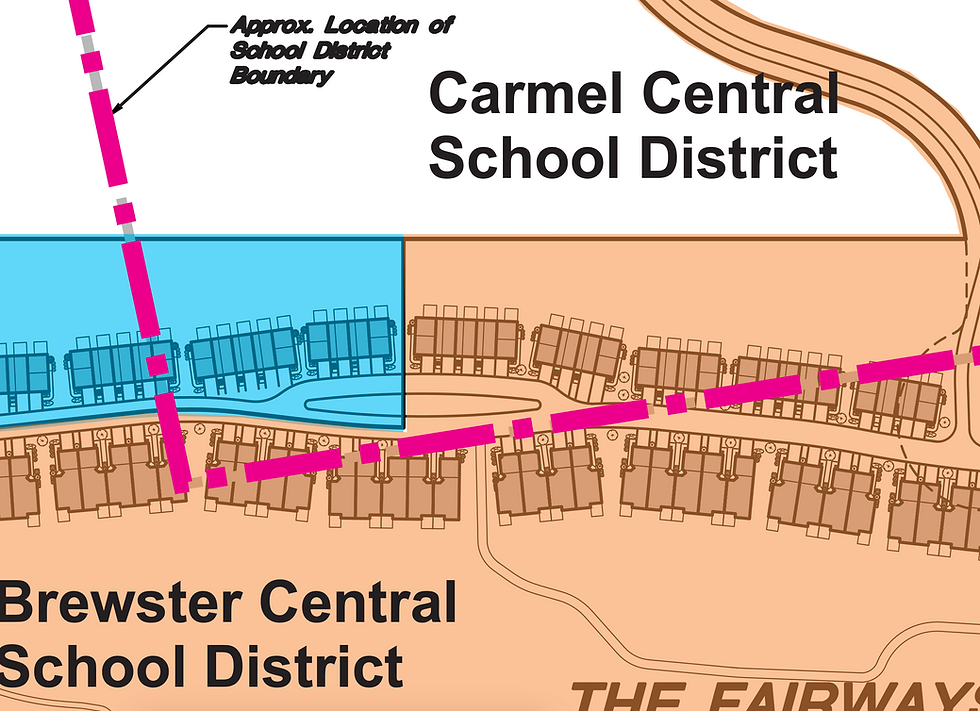
A housing development under construction in the Town of Carmel that straddles the boundary line between the Brewster and Carmel school districts – not only dissecting streets, but in some cases, homes – has the districts negotiating over the potential students that could be added to each, and the added taxable assessed value that comes with them.
“This is not a unilateral decision by the Brewster Board of Education,” explained Victor Karlsson, assistant superintendent for finance and operations at Brewster, during the Oct. 28 Brewster School Board’s workshop meeting. “It’s a negotiation between both Brewster schools and Carmel schools.”
Camarda Realty Investments is in the process of developing 185 acres between Putnam Plaza and Route 312, with Gateway Summit offering age-restricted senior housing, and The Fairways offering family housing.
A previous environmental assessment review predicts a total of 93 students residing at the future housing development, with 68 going to Brewster and the remaining 25 going to Carmel, if the district boundaries remain.
It seems both districts are in agreement that all the kids who live in the development should attend the same schools, which would mean the boundary line would need to be adjusted.
Karlsson noted that having actual homes divided by the boundary presents a logistical nightmare when it comes to taxation and school district designation.
“You may have a situation where a home is bisected by the boundary line – they may be assessed in Brewster schools but are eligible to attend Carmel schools,” he said. “They attend Carmel schools. Carmel then bills Brewster, and Brewster has to pay Carmel the property taxes collected on that home… It is a very challenging situation to be in and we are trying to avoid it.”
Three scenarios exist for the school districts.
The first is that the boundary line is kept where it is, which essentially means the districts cannot come to an agreement. This would increase Brewster’s taxable assessed value by about $20 per $100,000 and, in turn, decrease the tax rate.
“Any time that you’re adding school taxable assessed value … the size of the pot (tax levy) is remaining the same,” explained Karlsson. “We’re not collecting any additional money as a result of these properties becoming taxable, but they’re essentially adding slices to the pie. And that means that everybody else’s slices are becoming smaller.”
The second scenario is what Carmel Town Tax Assessor Christopher Paleo recommends, which is adjusting the boundary line so that all the kids attend Brewster, which would increase the school taxable assessed value by another $3 per $100,000.
However, if Brewster gets all the kids – and the taxable assessed value of the homes they reside in – the district would give over some commercially zoned land to Carmel.
The last scenario would adjust the boundary line so that all the students go to Carmel, which would mean the Brewster taxpayer would lose that $20 per $100,000 of assessed value and forgo any future tax benefit from the development.
Brewster School Board member Jennifer Carpiniello asked what Brewster will get in return if Carmel takes all the students.
“If we give all of this taxable income to Carmel, what are we getting in return?” she asked. “We would be taking a very small amount of Carmel schools’ taxable assessed value if we (took on all the students). If we did it the other way and Carmel took all the kids, they’d be taking a lot more of ours.”
Paleo admitted that the give-and-take aren’t equal. “It would be unbalanced if it all went to Carmel – that’s the reality,” he said.
School Board President Kerry Cunningham said it seems as through the district is really only considering two options. “I feel like our choices are: we take them all, or we leave it as is,” she said.
Board member Louis Riolo Jr. said both districts need to remember what’s important.
“This isn’t a horse trade – it’s about kids. That for ‘sale sign’ that’s been up on the (commercial) property that we give up … it’s been for sale for 40 years,” he said, noting that he’s not concerned enough about handing it over to Carmel, to just keep the boundary line as it is.
Comments