


Victims of 1895 Tilly Foster Mine Collapse Honored
By Holly Crocco
For the second time within a year, the Putnam County Italian American Social Club has honored the immigrant miners who perished in the Tilly Foster Mine tragedy of Nov. 29, 1895.
The disaster made worldwide headlines, yet the 13 men themselves were never given a proper burial or memorial. Historical records suggest that at least seven of these Italian miners were laid to rest at St. Lawrence O’Toole Cemetery in Brewster, where a ceremony and final repose was held Nov. 29, 2025 – 135 years after the event.
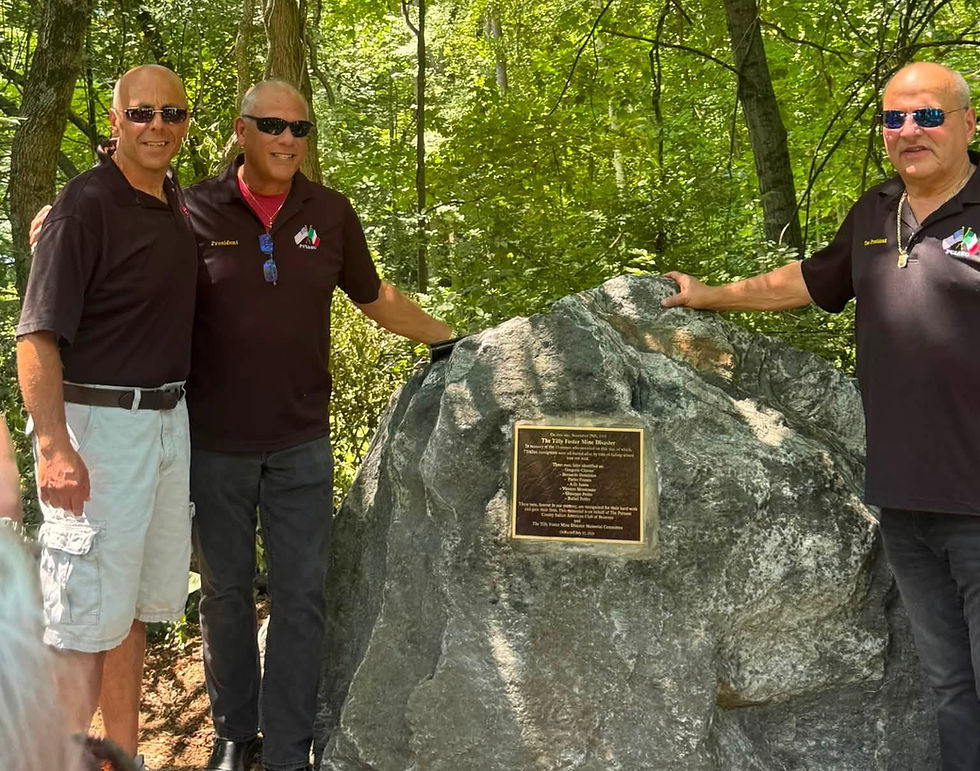
On Sunday, July 12, a newly placed monument and commemorative plaque were unveiled at the rail trail near the mine off Route 6. More than 100 people were in attendance for the dedication.
“At that time, the seven Italian men who lost their lives were only identified by numbers, rather than names,” according to Paul Anthony Fucito. “The Italians were all buried in an unmarked grave … perhaps together? It’s unknown.”
Seven Italians died –along with six others, including American-born miners who were evidently given decent burials with tombstones.
The Putnam County Italian American Social Club has been committed to ensuring that these men finally receive the honor and recognition they deserve, dedicating almost two years of planning to complete the task.
According to Town of Southeast Historian Jack Alcott, the Tilly Foster Mine was one of the 19th century’s most advanced iron mining operations, and its immense water-filled crater remains not far from the intersection of routes 6 and 312 in Brewster, off Old Mine Road and the present-day Empire State rail trail.
Using coal-burning steam engines, dynamite, draught animals, and men (mostly immigrants) armed with pick and shovel, the mine’s Gilded Age owners gouged out one of the largest man-made craters on Earth. In a time before meaningful safety regulations, it was dangerous, backbreaking work and not without tragedy.
On Nov. 29, 1895, the mine collapsed, crushing 13 miners under about 100 tons of rock 50 stories below.
Many of the pulverized miners were Irish and Italian immigrants whose mangled bodies were initially identified only by the numbers the company had assigned them; their names remained unknown until the coroner’s report the following January.
At its peak in 1879, Tilly Foster was churning out about 7,000 tons of ore a month and had shafts going down 600 feet.
Roughly 300 workers – many Italian, Irish, Welsh, and Swedish immigrants – were employed in the mines, along with mules, horses, and a small steam locomotive on a narrow-gauge railway used to carry the ore to the Brewster depot, where it was shipped out.
Miners were lowered the 50 stories into the Tilly Foster pit in giant open buckets suspended on cables from an overhanging crane. Other cranes and buckets lifted the ore to the surface. The ore was transported away from the mine by narrow-gauge rail locomotives right from the edge of the pit.
By the 1880s, as it became more difficult to excavate Tilly Foster’s ore via mine shafts, it was turned into an open pit.
The deadly mine collapse of 1895 and growing concerns about safety, along with the nearby flooding of the area for NYC reservoirs, conspired to end mining at Tilly Foster in 1897.
The remnant of the mine exists today near routes 6 and 312 as a huge, water-filled moon crater with sheer cliffs falling 50 or 60 feet into the water. The original mine shafts had drilled down about 50 stories below the surface, and the open pit itself is at least 400 feet deep and 200 yards across.
Comments